AI Beyond Pattern Matching: The Three Eras of How AI Predicts the Future
If you look closely at the current wave of generative AI, a sobering reality sets in: almost everything we call "artificial intelligence" today is actually just looking backward.
When we ask an AI to write a line of code, draft a strategy, or predict market trends, we aren't asking it to think. We are asking it to look at a mountain of historical data and make an educated guess.
To understand where the technology is actually going, we have to look at how AI processes time. The evolution of AI isn't just about getting "smarter"—it’s about moving from a system that remembers the past to a system that can simulate the future.
Here is the three-part framework defining the past, present, and frontier of AI.
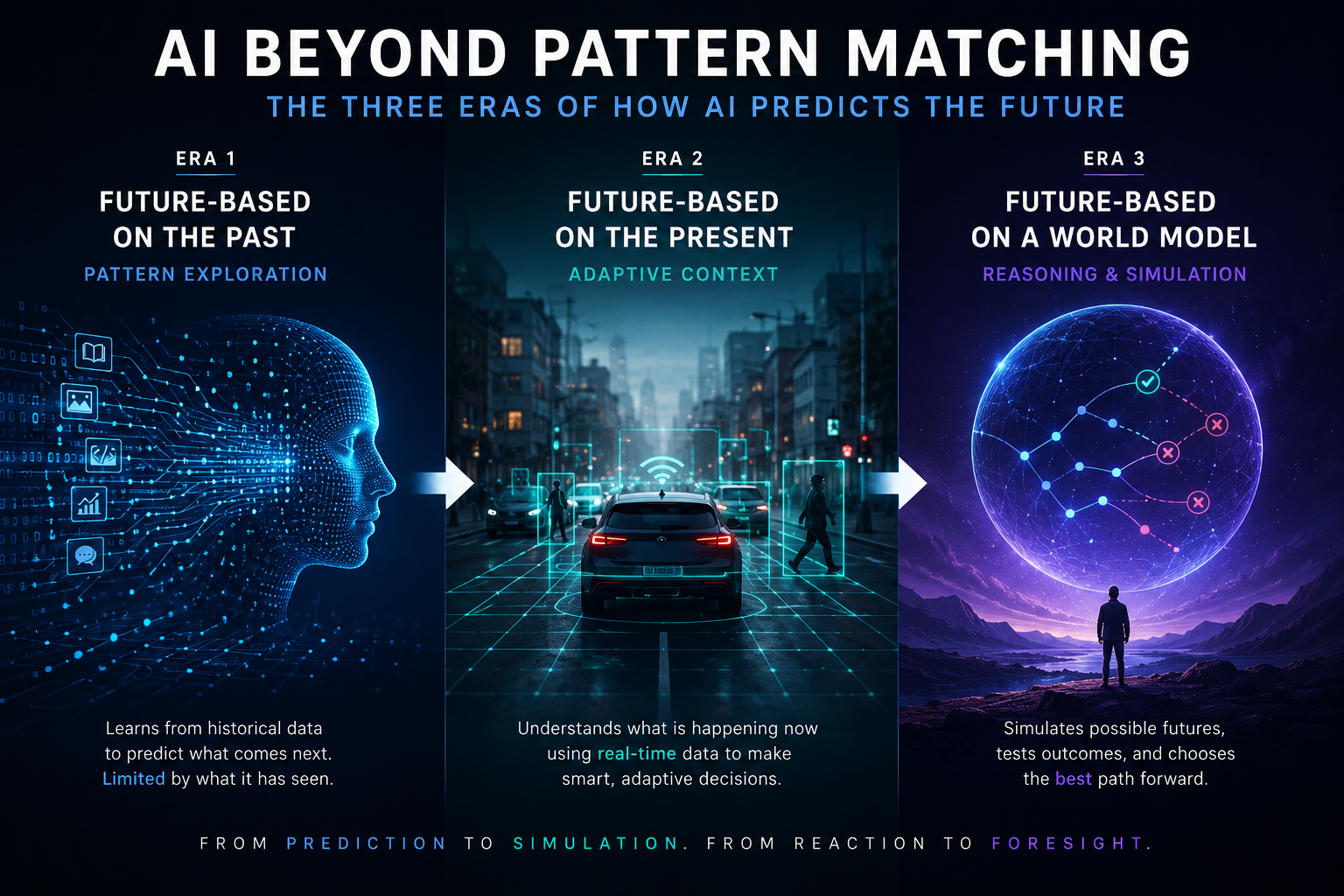
1. Today’s AI: Future-Based on the Past (Pattern Exploration)
The vast majority of modern AI systems—including the large language models operate entirely in this bucket. They are, at their core, pattern exploration machines. These models ingest billions of data points from historical human output. When you give them a prompt, they use those past statistical patterns to predict what should come next. Because they rely entirely on what has already happened, they struggle with novelty. When faced with a unique scenario, a model built on the past will often hallucinate or fail, because it lacks a historical map to guide it.
2. The Current Shift: Future-Based on the Present (Adaptive Context)
The next evolution moves away from static training data and into real-time environments. Instead of just relying on what it learned during training, the AI continuously ingests what is happening right now to make immediate decisions.
This is the realm of advanced robotics, self-driving systems, and real-time AI agents. A self-driving car cannot safely navigate a busy intersection relying only on "past" maps; it must process a pedestrian stepping off the curb at this exact millisecond to determine its next move. By combining foundational training with live, in-context data streams, AI transitions from a static knowledge base into an active, real-time navigator.
3. The Frontier: Future-Based on a World Model (Reasoning & Simulation)
This is the holy grail of modern AI: moving from machines that remember to machines that reason.
Instead of just reacting to past data or present stimuli, the AI builds an internal "world model." Before it takes an action or delivers an answer, it uses Reinforcement Learning (RL) to run thousands of internal simulations. It maps out hypothetical futures: "If I take path A, what happens? What about path B?" It tests its own logic, catches its own errors, and optimizes its output before it ever interacts with the real world.
This shifts AI from a reactive tool to a predictive partner capable of strategic foresight and complex problem-solving.
The Paradigm Shift
We are rapidly moving past the era where AI is just a highly efficient lookup engine for human history. As world models and reinforcement learning mature, the true value of AI won't be its ability to tell you what has worked—it will be its ability to simulate what will work.
The future of technology isn't just about faster execution; it's about deeper simulation.