LLM-based AI is not the answer to the Manufacturing Industry
The manufacturing industry is an important pillar of the economy. This industry is extremely data-rich. The proper use of AI can generate significant business impact.
AI adoption is increasing every day, thanks to the rapid development of LLM-based AI. LLM-based AI systems like ChatGPT, Claude, and others can write, summarize, translate, reason over text, generate code, and interact with people effectively. Because most people use these tools and provide feedback on their outputs, leading LLM companies continually release improved models. These systems are definitely helpful for personal productivity and support-oriented work.
For the manufacturing industry, however, LLM-based AI cannot serve as the primary intelligence layer. LLMs are useful for information-based problems, but the critical challenge in manufacturing is not information—it is the interconnected operational chain.
Manufacturing requires deep causal intelligence to understand relationships, dependencies, root causes, and downstream impacts across the enterprise.
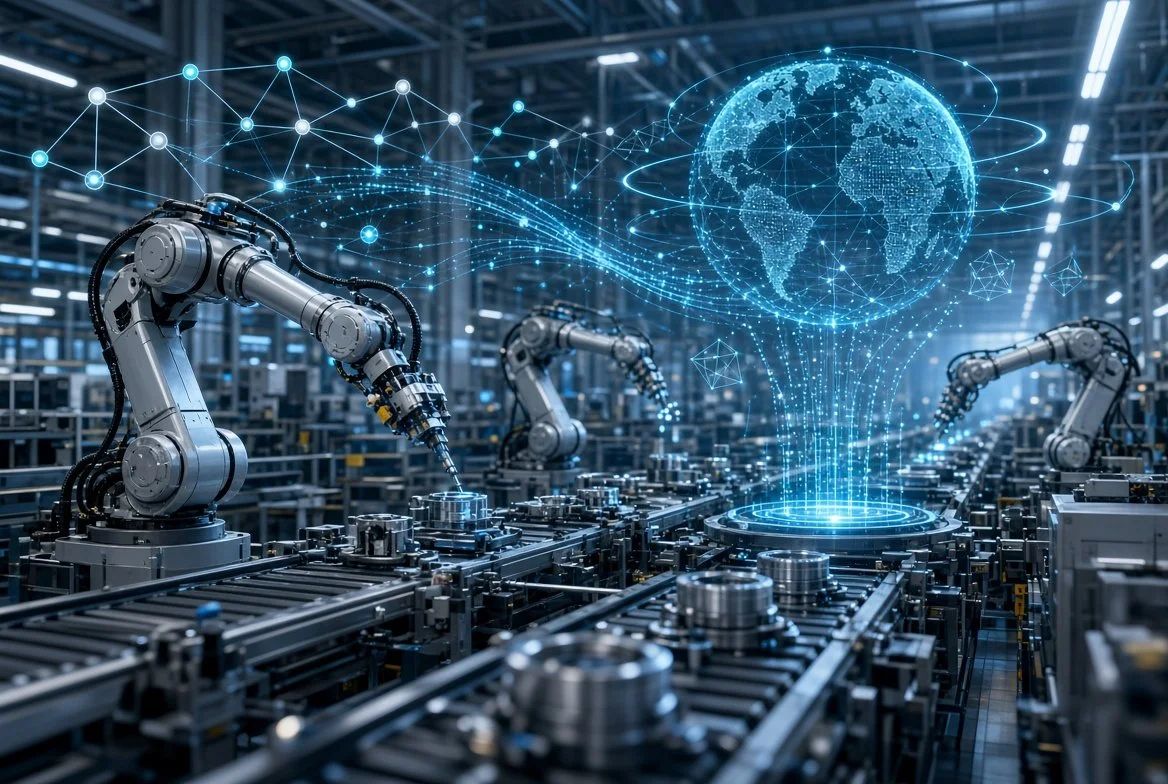
Manufacturing requires system understanding
A manufacturing enterprise operates through machines, processes, materials, constraints, dependencies, quality parameters, inventory, demand, schedules, people, and physical outcomes. Everything is connected. A change in one part of the system can propagate through the entire operation.
Every system in the manufacturing value chain affects the others. It forms a network of relationships, constraints, states, and physical processes. A manufacturing enterprise is a system of tightly coupled physical and operational realities:
Machines have throughput limits, setup times, failure modes, and maintenance windows.
Processes have sequence constraints, recipe tolerances, and quality gates that cannot be violated without causing scrap or rework.
Materials and inventory interact with lead times, lot sizes, shelf life, and supplier variability.
Demand fluctuates while capacity remains largely fixed in the short term.
Time is not abstract; it is measured in cycle times, changeovers, and the irreversible progress of a batch through a plant.
These relationships are causal and constrained. Changing one variable produces predictable and often non-linear effects elsewhere. LLMs do not inherently model those causal structures. They can describe them if the description appears in training data or context, but description is not the same as simulation, optimization, or reliable decision-making under physical constraints.
The intelligence manufacturing needs
The manufacturing industry requires a different kind of intelligence. Vertical AI (or Industrial AI) for manufacturing —a structured, causal representation of the entire operation that can:
Represent and reason over the causal fabric of the enterprise itself: machines, processes, materials, constraints, quality gates, inventory dynamics, and the physical consequences of every action.
Perform goal-based optimization that respects hard operational limits while searching for better schedules, recipes, maintenance policies, or resource allocations.
Run constrained, high-fidelity simulations that let planners and operators test decisions and observe downstream effects before committing real resources, time, or materials.
Unlike general-purpose LLMs, which primarily describe or retrieve information, a manufacturing world model is designed to simulate, intervene, and optimize under real physical and operational constraints. It becomes the core intelligence layer on which reliable decision-making in the plant is built.
For manufacturing, the real opportunity lies in using AI that understands the operational system itself: its causal relationships, constraints, dynamics, objectives, and physical consequences. That is the foundation for reliable, goal-driven intelligence in industry.